Original research brief
AI Data Privacy Workflow for Small Business Implementation Checklist
A practical guide to AI data privacy workflow for small business implementation checklist, with decision checks and a repeatable workflow for small teams.
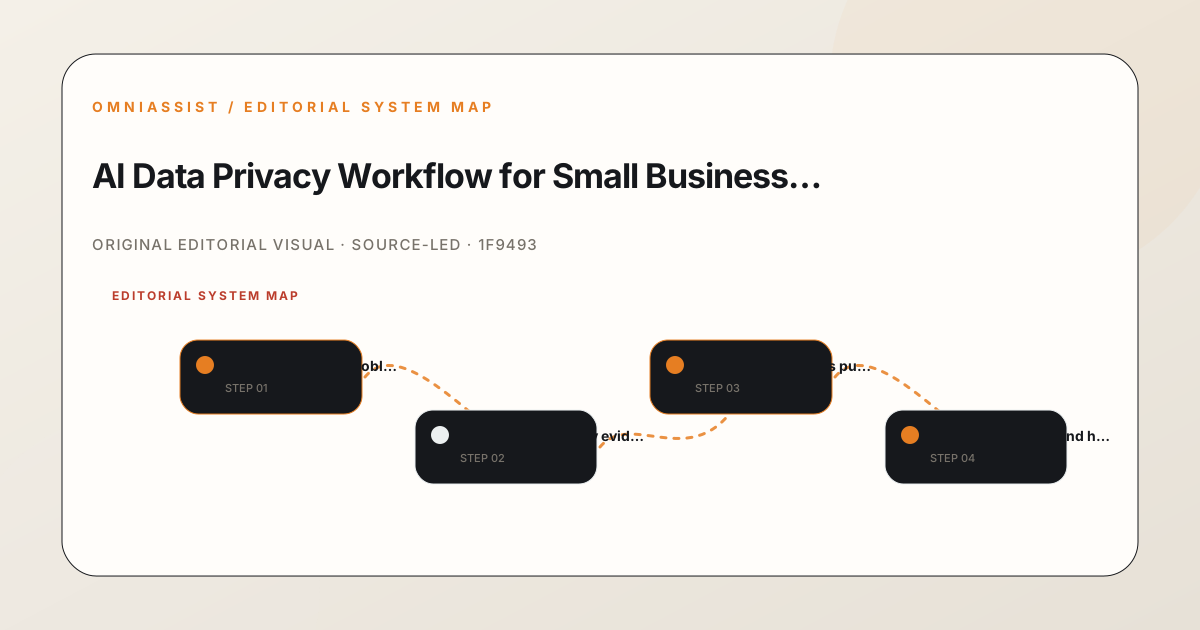
A practical guide to AI data privacy workflow for small business implementation checklist, with decision checks and a repeatable workflow for small teams.
Every image is selected for a distinct editorial role, then checked for source, rights and fit before it enters the story.
The AI Omnibus entered into force on 27 July 2026, extending timelines for high-risk AI systems and simplifying obligations for smaller companies.
The AI Office has published guidelines for providers and deployers of high-risk AI systems, transparency obligations, and practical application of high-risk requirements.
From 2 August 2026, the European Commission's AI Office and national authorities began enforcing the AI Act, with new transparency rules for AI-generated content.
The AI Act defines four levels of risk for AI systems: unacceptable, high, transparency, and minimal or no risk.
The problem is not that AI tools are risky. It is that most small businesses cannot say, with confidence, what data goes into a tool, who can see it, how long it is kept, and what happens when something goes wrong. That uncertainty is the real exposure. This guide gives you a repeatable workflow for data privacy that fits a small team. The intended outcome is a working register of AI uses, data flows, retention rules, and review points. You will not become a compliance department. You will be able to answer the questions that owners, clients, and regulators actually ask. The method is deliberately modest: inventory, control, evidence, review. Each step has a clear output. If you cannot produce that output, you have found a gap worth fixing before you scale the use of AI.
Before you write a policy or buy a tool, decide what counts as evidence. The EU AI Act and its supporting guidelines are a useful anchor because they are public, structured, and risk-based. The AI Office has published guidelines for providers and deployers of high-risk systems, transparency obligations, and practical application of high-risk requirements. The AI Omnibus, in force since 27 July 2026, extends timelines and simplifies obligations for smaller companies. That matters because it changes what you need to document. Do not rely on vendor marketing pages or blog summaries. Go to the primary source, note the publication date, and check whether it has been amended. For a small business, the practical rule is simple: if you cannot link a claim to a dated public source, treat it as an assumption, not a fact. Keep a short list of sources you trust and update it when the rules change.
Start with a plain-language inventory. For each AI tool you use, write down what data goes in, why it goes in, who can access it, and how long it is retained. Do this for every tool, including free trials and internal experiments. A spreadsheet is fine. The act of writing it down forces decisions. For each data flow, ask three questions. First, is the data necessary for the task, or are you sending more than you need? Second, is the purpose clear enough to explain to a client or an employee? Third, what happens to the data after the task is done? If the answer to any question is unclear, that is a control gap. Retention is not a technical detail. It is a business decision about how long you are willing to be responsible for data you no longer need. Set a default retention period and review it at least once a year.
Access control is about who can see what, not just who has a password. For each AI tool, define roles: who can send data, who can review outputs, and who can change settings. The smallest sensible setup is two roles: an operator and a reviewer. The operator runs the tool. The reviewer checks that the use matches the purpose in the register. This separation is not bureaucracy. It is the control that catches mistakes before they become incidents. Vendor controls matter too. Check whether the vendor stores data in a region you are comfortable with, whether they use your data for training, and whether you can export or delete your data on request. Write down the answers. If a vendor cannot give you clear answers, treat that as a risk signal. Human oversight is not about watching every output. It is about having a named person who is accountable for each AI use and a defined escalation path when something looks wrong.
Evidence is what you can show when someone asks how you manage AI data privacy. It does not need to be elaborate. For each AI use, keep three things: the purpose, the data flow, and the review record. The purpose is a sentence explaining why you use the tool. The data flow is the inventory entry showing what goes in and out. The review record is a dated note of who checked the use and what they found. This is enough to support an internal review or a conversation with a client. If you are in a sector with specific obligations, such as health or education, you may need more. The EU AI Act guidance on high-risk systems and fundamental rights impact assessments is a useful reference for those cases. The point is not to build a file for its own sake. It is to make the invisible visible. When the evidence is in place, you can answer questions without scrambling.
A register is only useful if it reflects what you actually do. Set a simple review cycle. Once a month, check whether any new tool has been added, any existing use has changed, or any data flow has been removed. Update the register on the same day you make the change, not at the end of the quarter. Small teams drift because the register becomes a document that nobody reads. To avoid that, tie the register to a real event. For example, review it before you renew any software subscription or before you onboard a new client. That makes the review a decision point, not an administrative chore. If you find that a use is no longer necessary, remove it and note the deletion. If you find a new use, add it before you start. The discipline is the same as keeping a budget: you track it because you need to know where you are.
The final step is to make the workflow measurable. Choose one metric that tells you whether the system is working. A good starting metric is the number of AI uses with a complete register entry, expressed as a percentage of all active uses. If that number is below 100 percent, you have a clear action. Another useful metric is the time between a change in workflow and the update to the register. If it is more than a week, the process is too slow. You do not need a dashboard. A simple monthly check is enough. The next step is concrete: pick one AI tool you use today, complete the inventory entry for it, and set a review date. That is the whole method. It is not glamorous, but it is repeatable, and it gives you a defensible answer when someone asks how you handle data privacy. Start with one tool, then extend the method to the rest.
The first step is to inventory every AI tool you use and write down what data goes in, why it goes in, who can access it, and how long it is retained. This includes free trials and internal experiments. A simple spreadsheet is sufficient. The act of writing it down forces you to make decisions about necessity, purpose, and retention. If you cannot answer these questions for a tool, you have found a control gap that needs attention before you scale the use of that tool.
The EU AI Act introduces a risk-based framework for AI systems. For small businesses, the practical effect depends on what you use AI for. The AI Omnibus, in force since 27 July 2026, extends timelines for high-risk systems and simplifies some obligations for smaller companies. The AI Office has published guidelines on transparency, high-risk requirements, and practical application. You should check whether your use cases fall into high-risk categories, such as recruitment or credit scoring, and keep evidence of your data flows and review processes.
An AI data privacy register should include, for each AI tool, the purpose of the use, the data flow (what goes in and out), the retention period, the named operator and reviewer, and the vendor's data handling practices. It should also include a dated review record showing who checked the use and what they found. The register is a working document, not a static file. It should be updated whenever a tool is added, changed, or removed, and reviewed at least monthly.
A small business should review its AI data privacy workflow at least monthly, and more frequently if the business is growing or changing its tooling. The review should check whether any new tools have been added, whether existing uses have changed, and whether any data flows are no longer necessary. The register should be updated on the same day a change is made. Tying the review to a real event, such as a software renewal or a new client onboarding, makes it a decision point rather than an administrative chore.
The minimum evidence is three things for each AI use: a sentence explaining the purpose, the inventory entry showing the data flow, and a dated review record. This is enough to support an internal review or a conversation with a client. If you are in a sector with specific obligations, such as health or education, you may need more, and the EU AI Act guidance on high-risk systems is a useful reference. The point is to make the invisible visible so you can answer questions without scrambling.