Original research brief
AI News Business Impact Review Implementation Checklist
A practical guide to reviewing AI announcements for business impact, with a step-by-step checklist to separate evidence from hype and decide what to test…
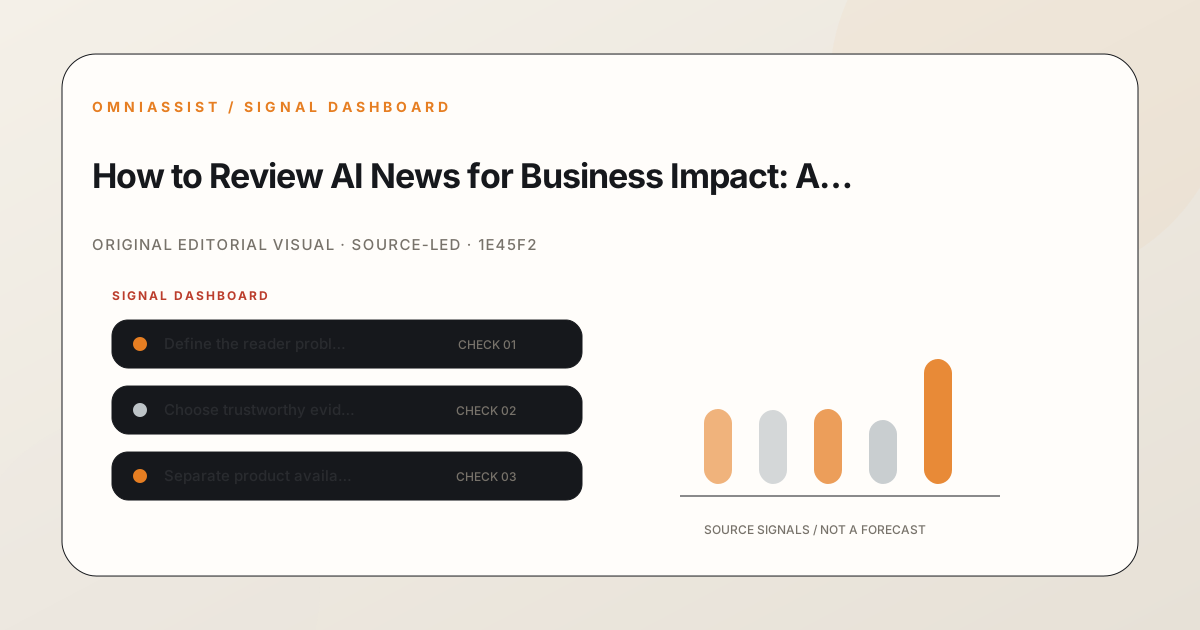
A practical guide to reviewing AI announcements for business impact, with a step-by-step checklist to separate evidence from hype and decide what to test…
Every image is selected for a distinct editorial role, then checked for source, rights and fit before it enters the story.
According to the Hugging Face – Community Blogs, the platform hosts a continuous stream of community articles and model releases.
According to 'Extremely Fast and Accurate Transcription with Granite Speech 5.0 Turbo CTC', the model's performance is evaluated against public test sets from the OpenASR Leaderboard.
According to 'Writing Down the Line Between Luck and Skill', the financial forecasting contest includes a self-test for its scoring code to prevent lookahead errors.
According to 'ArmBench-ASR: A Benchmark for Armenian ASR', model performance is strongly domain-dependent, varying significantly between read speech, poetry, and movies.
The problem is not a lack of AI news. It is the difficulty of deciding which announcements warrant a change in your own work. According to the Hugging Face – Community Blogs, the volume of community articles and model releases creates a constant stream of new capabilities. Your intended outcome is a clear, defensible decision: to test, to watch, or to ignore. Start by writing down the specific business process you suspect could be improved. Is it customer support transcription, financial forecasting, or something else? Be precise. A vague sense that 'AI could help' leads to wasted effort. The outcome is not a list of interesting tools. It is a single documented choice about where to focus your next evaluation cycle. This turns the noise into a filter.
Trustworthy evidence comes from primary sources, not summaries. According to 'Extremely Fast and Accurate Transcription with Granite Speech 5.0 Turbo CTC', the model's performance is detailed against specific public test sets from the OpenASR Leaderboard. This is a verifiable claim grounded in a measurable benchmark. Your first action is to locate the original announcement. Look for the release notes, the technical blog post, or the research paper. Secondary commentary often amplifies the hype and omits the limitations. Your second action is to check for a self-contained evaluation method. Does the source explain how it measured the result? According to 'Writing Down the Line Between Luck and Skill', the contest design includes a self-test for the scoring code to prevent lookahead errors. This level of methodological transparency is a strong signal. If you cannot find the primary source or its evaluation method, treat the announcement as a direction of travel, not a ready-to-use fact.
An announcement can signal a research breakthrough, a product launch, or a partnership. Your job is to classify it. According to 'ArmBench-ASR: A Benchmark for Armenian ASR', the benchmark itself is available for evaluation, while the top-performing model is a closed system. The available component is the benchmark; the closed model is a signal of capability, not an immediately deployable tool. Ask a simple question: what can you download, query via API, or run in a space today? If the answer is nothing, the announcement is purely directional. This is not a reason to dismiss it. It is a reason to file it under 'market intelligence' rather than 'implementation candidate'. For example, a new architecture described in a research blog is a future direction. A model checkpoint released under an Apache license is a product. This separation stops you from planning a project around vapourware.
Claims are not useful until you turn them into questions you can answer yourself. Take the claim 'unprecedented speed' from the Granite Speech announcement. The testable business question is: 'Would a transcription speed of over twelve thousand real-time factors materially reduce the latency in our customer support ticket logging?' You are not testing the claim's truth—the benchmark does that. You are testing its relevance. According to 'Writing Down the Line Between Luck and Skill', the contest measures skill by having entrants take a position, not just make a prediction. Apply the same principle. Move from passive assessment ('this looks fast') to active interrogation ('would this speed change our workflow?'). Write down three to five such questions for any announcement you are seriously considering. This forces you to connect the external signal to your internal reality. If you cannot formulate a clear question, the claim is not yet actionable for you.
A bounded trial has a fixed scope, a fixed duration, and a clear pass/fail criterion. Do not attempt a full integration. Instead, isolate one step of your current workflow and substitute the new method for a limited time. For instance, if evaluating a new transcription model, take one day's worth of support calls and process them with the new service alongside your existing method. Compare the outputs on accuracy and latency only. The goal is not to prove a broad superiority. It is to identify any deal-breaking failure modes or unexpected costs. According to the Hugging Face – Blog, many community articles include interactive demos or spaces. Use these for your initial, zero-integration trial. The bounded nature of the test protects your operational continuity. It also gives you a concrete result to discuss: 'We tried it on fifty samples and observed X.' This is evidence, not opinion.
After your review and any trial, you must make a decision. Record it in writing, along with the evidence that led you there and, crucially, the evidence you still lack. For example: 'Decision: Do not proceed with integrating Model A for transcription. Evidence: Our bounded trial showed a higher word error rate on accented speech than our current provider. Missing evidence: Whether fine-tuning on our domain audio would close the gap, and at what cost.' This record serves several purposes. It creates accountability for your choices. It builds an institutional memory of past evaluations. And it defines the precise conditions under which you would revisit the decision. According to 'ArmBench-ASR: A Benchmark for Armenian ASR', the benchmark reveals that model performance is strongly domain-dependent. Your missing evidence should often concern your specific domain. This step turns a one-off review into a repeatable audit trail.
The final output of your review is not a report. It is a single, measurable next step. If the decision is to proceed, the next step might be: 'Schedule a two-hour technical spike to prototype an API connection.' If the decision is to wait, the next step could be: 'Check the project's GitHub repository for a production-ready release in three months.' The step must be concrete and assigned to someone. This prevents the common failure mode where interesting news leads to endless discussion but no action. It also prevents the opposite failure: leaping into a major project based on a headline. The entire checklist you have just applied is a method for generating that next step with deliberate speed. Your goal is to move from being a consumer of AI news to being a strategic evaluator of it. The measurable next step is the proof that you have done so.
Find the primary source. Do not rely on summaries or commentary. Look for the official blog post, research paper, or release notes from the organisation that created the technology. Read it for the stated capabilities, the disclosed evaluation method, and the licence or availability terms. This first step grounds your entire review in verified facts rather than third-party hype.
Translate the announcement's claims into testable questions about your specific workflows. If a story highlights a new speech model, ask whether transcription accuracy or speed is a documented bottleneck in your operations. If you cannot formulate a clear, specific question that links the news to a known problem or opportunity, it is not immediately relevant. File it for future reference instead.
A bounded trial is a limited-scope, time-boxed test of a new tool or method against your current workflow. It is designed to gather concrete evidence without disrupting operations. For example, processing a small, representative batch of data with a new API. Its importance lies in converting abstract potential into observed performance and failure modes, providing a factual basis for any larger investment decision.
Recording missing evidence creates a clear threshold for reconsideration. It turns a 'no' decision into a conditional 'not yet,' defined by specific gaps in knowledge. This prevents repeated circular debates and allows you to efficiently revisit the topic later if those specific conditions change or new information emerges, making your evaluation process more efficient over time.
Apply a strict filter based on your predefined business problems. Do not review announcements generally. Only engage deeply with news that appears to connect to a workflow you have already identified as a candidate for improvement. For all other news, a quick scan of the headline and source is sufficient. This turns the firehose into a curated feed aligned with your strategic priorities.