Original research brief
EU AI Act Readiness for Small Business Implementation Checklist
A practical guide to EU AI Act readiness for small business implementation checklist, with decision checks and a repeatable workflow for small teams.
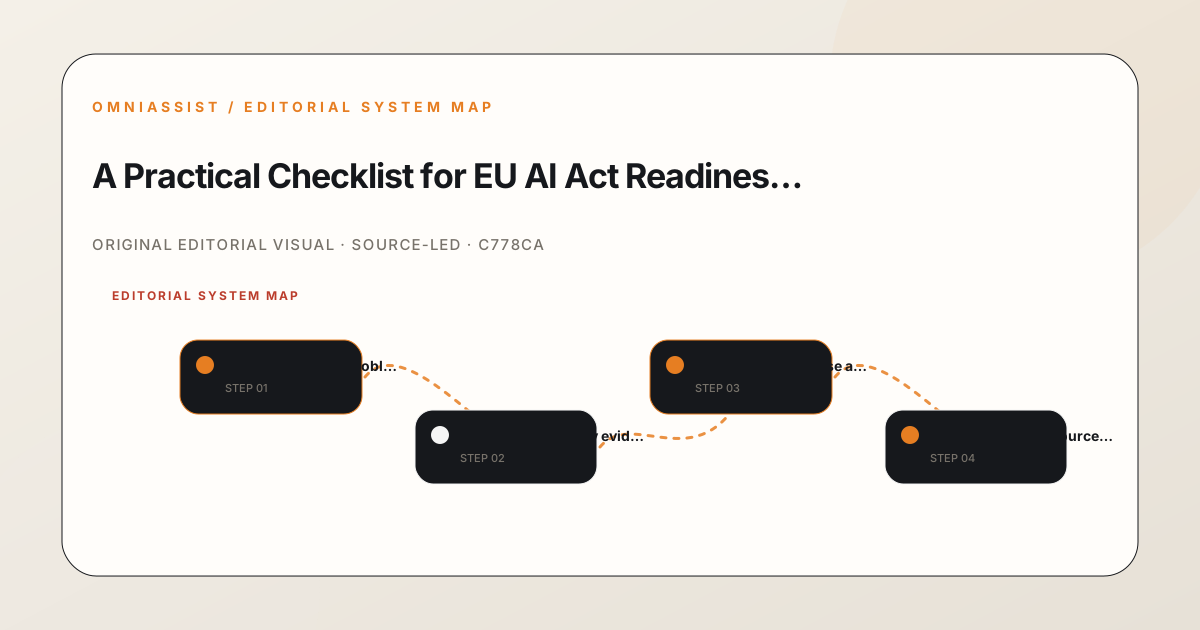
A practical guide to EU AI Act readiness for small business implementation checklist, with decision checks and a repeatable workflow for small teams.
Every image is selected for a distinct editorial role, then checked for source, rights and fit before it enters the story.
According to 'AI Act', the framework defines four levels of risk for AI systems: unacceptable, high, transparency, and minimal.
According to 'Supporting the implementation of the AI Act with clear guidelines', the AI Office has published guidelines for providers and deployers of high-risk AI systems.
According to 'EU agrees to simplify AI rules to boost innovation and ban ‘nudification' apps to protect citizens', rules for high-risk AI systems in certain areas apply from 2 December 2027.
According to 'AI Omnibus enters into force', the AI Omnibus entered into force on 27 July 2026, introducing extended timelines and simplification for smaller businesses.
The practical question is not whether the AI Act applies, but where your own systems sit within its risk categories. According to the official source 'AI Act', the framework defines four levels of risk, from unacceptable to minimal. For a small team, the immediate problem is mapping your own uses against that structure without assuming you need a lawyer on retainer. The intended outcome is a clear, internal inventory that separates what you must act on from what you can monitor. I find the failure mode here is treating the regulation as a monolithic compliance burden instead of a set of specific obligations tied to specific uses. Start by asking which of your AI tools interact with people's rights, safety, or access to services. A customer support chatbot, for instance, presents a different set of questions than an internal code-review agent. Your first step is to define the problem as a classification exercise, not a legal conclusion.
Your inventory is only as good as the definitions you use. According to 'Supporting the implementation of the AI Act with clear guidelines', the AI Office has published guidelines for providers and deployers of high-risk systems, alongside templates for reporting serious incidents. This is your primary evidence. Do not rely on secondary summaries or vendor claims of compliance. The editorial method is to download the official guidelines and use their criteria as your checklist headings. For example, the guideline on transparency obligations for providers and deployers of certain AI systems gives you concrete questions to ask about your own interfaces. A failure signal is when your preparation document cites blog posts instead of the Commission's own texts. Ground every observation in a direct source. If a source mentions that rules for high-risk AI systems in certain areas apply from a specific date, note that as a fact for your timeline, but do not extrapolate it to your own situation without a qualified review. Your evidence should be the regulation, the official guidelines, and your own system documentation—nothing else.
This is the core of the method. List every AI system you deploy, purchase, or develop. For each, record its intended purpose in plain language. According to 'AI Act', high-risk use-cases include AI tools for employment, management of workers, and access to essential private and public services. If your inventory includes a tool that screens job applications, that entry must be flagged. The practical step is to create a simple table: system name, its function, the data it uses, and the human decision it informs or automates. The trade-off is between brevity and usefulness; a one-word description is useless, but a three-page essay is unmanageable. Use the source's categories as prompts. Does the tool perform biometric categorisation? Does it influence access to a service? This is not a legal assessment, it's a factual log. The failure mode is vagueness. 'Marketing AI' is not a sufficient description. 'Email subject-line generator for newsletter campaigns' is better. This inventory becomes your single source of truth for all subsequent steps.
An AI system does not operate in a vacuum; it sits inside a human workflow. For each item in your inventory, document who oversees it and which business processes it touches. According to 'Guidelines for providers and deployers of AI high-risk systems', deployers have specific obligations for human oversight. In a small business, the overseer might be the founder, a team lead, or an external consultant. The key is to name them. Next, trace the workflow. If a chatbot handles initial customer queries, where do complex issues get handed off? What is the failure signal that triggers human review? This mapping serves two purposes. First, it identifies gaps in oversight—systems that run without any defined owner. Second, it highlights processes that may need redesign to meet transparency requirements. According to 'Commission starts enforcing AI Act rules and new transparency requirements on 2 August', new transparency rules require certain AI systems to inform users when they are interacting with AI. Your workflow must accommodate that disclosure. Record this now, so you know what to change later.
This is the most common point of failure. Your checklist is an operational tool to organise facts, not a substitute for qualified legal counsel. According to 'EU agrees to simplify AI rules to boost innovation and ban ‘nudification' apps to protect citizens', the simplification measures are designed to make implementation easier for businesses. Your job is to prepare the materials a lawyer would need to give you advice: your completed inventory, your workflow maps, and your questions. The distinction is crucial. Operational preparation involves gathering documentation, testing disclosure mechanisms, and ensuring your team knows where the AI tools are used. Legal advice interprets those facts against the law. For example, you can prepare a draft transparency notice for your chatbot. A lawyer should review its wording. The failure mode is conflating the two and either doing nothing for fear of legal cost or making assumptions that create risk. Your method must keep these tracks separate but connected.
Your inventory and maps are living documents. According to 'AI Omnibus enters into force', the updates introduce extended timelines for certain high-risk systems embedded in physical products. This means your evidence must be maintained, not filed away. Set a quarterly review to update the inventory with new tools or changed purposes. The practical step is to attach your evidence to a recurring calendar task and assign an owner. The review should check for new guidelines from the AI Office, which, according to 'Supporting the implementation of the AI Act with clear guidelines', is continuously publishing new practical instructions. A failure signal is a static document that hasn't been opened since creation. The evidence you maintain—your source documents, your inventory, your review notes—forms an audit trail that demonstrates diligence. It does not prove compliance, but it does show a systematic approach. This is the difference between being unprepared and being ready for a qualified review, whether internal or external.
A checklist is useless without a clear next action. Your outcome from this process should be a single, measurable task. For most teams, that task is: 'Complete the first draft of the AI system inventory by [date].' According to the official sources, the framework is built for incremental implementation. The 'AI Act Single Information Platform' is cited as a resource for stakeholders. Your next step could be to visit that platform and bookmark the guidelines relevant to your inventory. The failure mode is to treat this as a research project with no deadline. Instead, define a concrete output: a shared document with the first five entries completed. Then schedule the first quarterly review. The method turns regulatory complexity into a manageable operation. It does not solve the problem for you, but it gives you the tools to start solving it yourself, with clarity on what you know and what requires expert input. That is the only sensible way to proceed.
The first practical step is to create an inventory of every AI system you use, develop, or purchase. For each entry, document its specific purpose, the data it uses, and the human decision it informs. This factual log, grounded in the AI Act's own risk categories, forms the basis for all subsequent analysis. Do not start with legal research; start with your own facts.
Consult the official 'AI Act' source directly. It lists specific high-risk use-cases, including AI tools for employment, access to essential services, and education. Compare your system's intended purpose against these descriptions. This is a classification exercise, not a legal judgment. If your use matches a described category, flag it in your inventory for further review.
According to the guidelines, a provider develops or places an AI system on the market, while a deployer uses it under their authority. For a small business, you are likely a deployer of third-party tools. This distinction matters because obligations differ. Your inventory should note for each system whether you are the provider, deployer, or both.
According to 'Commission starts enforcing AI Act rules and new transparency requirements on 2 August', new transparency rules require certain AI systems to inform users when they are interacting with AI. The specifics depend on the system's risk classification and use. Your inventory and workflow mapping will help identify which of your tools need to incorporate these disclosures.
Treat your inventory and evidence as living documents. Set a quarterly review to update them for new tools, changed purposes, and newly published official guidelines. According to sources, the AI Office is continuously releasing new guidance. A regular review cycle ensures your operational preparation stays current without becoming a constant burden.